

Why Sustainability Is One of the Most Powerful Marketing Levers for North American Brands



Sustainability has moved beyond compliance and purpose-led messaging to become one of the most powerful drivers for enterprise organizations.
For successful businesses, sustainability can no longer be primarily an operational or compliance issue. To maximize gains, it should become a front-line marketing asset, one that shapes brand value, purchase decisions, customer advocacy, and long-term cost effectiveness in acquiring and retaining customers.
In an environment of rising inputs and supply chain, media costs, declining trust in advertising, and increasing consumer skepticism, sustainability is emerging as a key brand strategy that simultaneously drives growth, differentiation, and credibility for the long-term.
This is not only about purpose for its own sake. It is about long term brand health and profitability when enacted authentically, as part of your brand DNA.
Sustainability as a Brand Value Multiplier
Enterprise brand value is built on trust, relevance, and emotional connection at scale. Sustainability strengthens all three. Several long-term studies have shown that brands that integrate and activate their stance on sustainability outperform brands that have no stance or make CSR statements alone. One such study showing higher brand value was fielded by McKinsey:
ESG-driven strategy improves shareholder returns beyond peers
Analysis by McKinsey shows that companies integrating ESG priorities into growth strategy not only meet but surpass the financial performance of peers. “Triple outperformers” - companies excelling in growth, profitability, and sustainability - delivered higher total shareholder returns compared to firms that outperform on financial metrics alone.
Brands that integrate sustainability authentically signal:
Long-term positioning
Accountability and transparency
Alignment with their customer values
Leadership beyond short-term profit
For large organizations, this matters because brand equity increasingly determines:
Consideration and preference
Willingness to engage
Resilience during crises
Share of voice beyond paid media
Sustainability has become a brand credibility ‘signal’ shortcut. In markets crowded with functional parity, it differentiates brands on meaning, not just message. Sustainability does not replace brand strategy, it amplifies it. Sustainability as a Purchase Driver, Not a Brand “Nice to Have” A persistent misconception among senior leaders is that sustainability influences perception but not purchasing behaviour. Research shows this is no longer true. IMI Research: Sustainability Drives Buying Behaviour IMI research demonstrates that all North American consumers, especially Gen Z and Millennials - now a large and fastest-growing buyer cohorts - show:
High purchase intent toward sustainable brands
High purchase intent if it supports eliminating climate change
Crucially, sustainability is not perceived as a premium feature. It is increasingly embedded in how customers define value and quality.
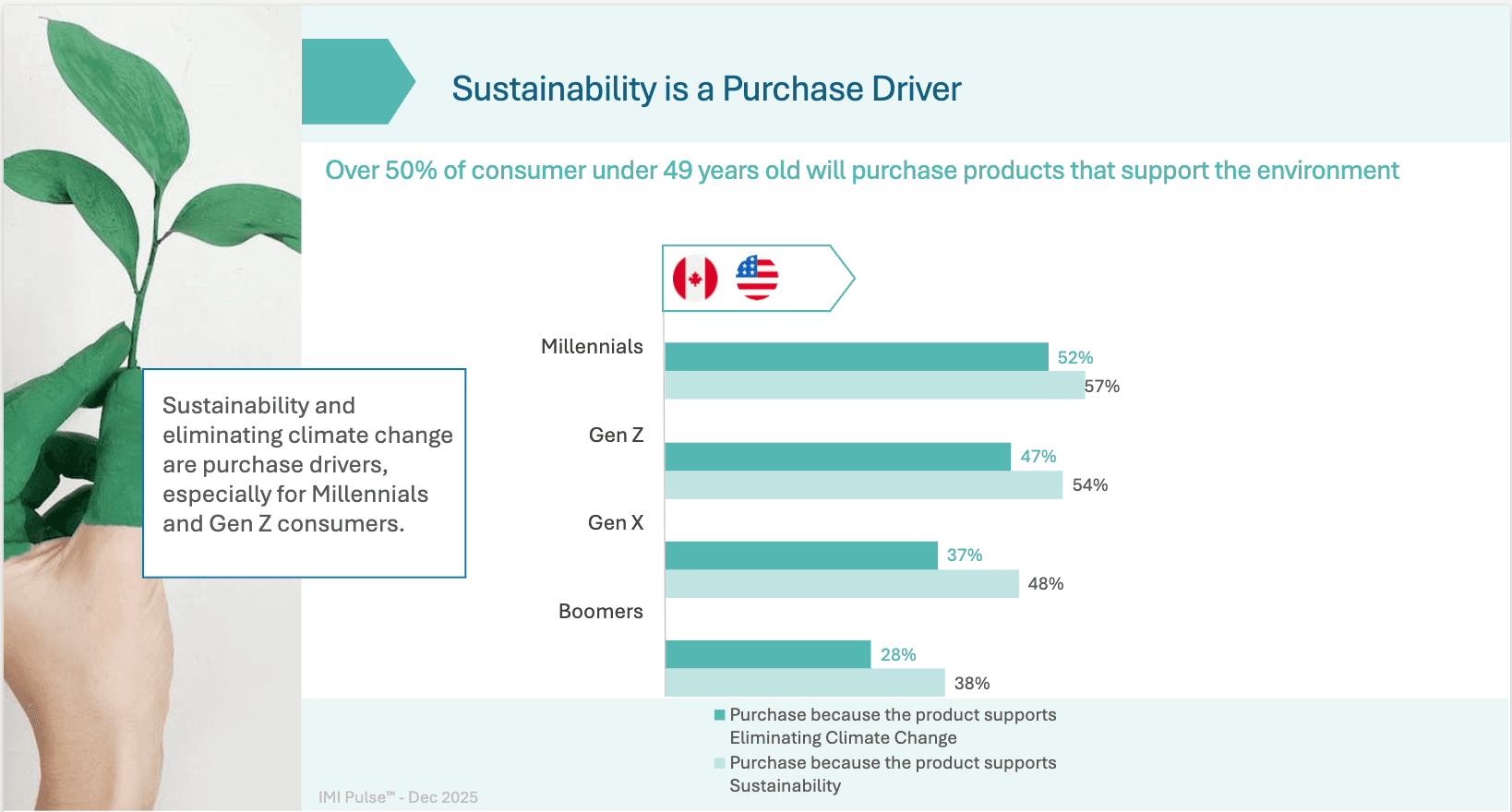
For enterprise marketers, this translates into:
Higher customer lifetime value
Stronger brand stickiness
Improved conversion rates (from aware to purchase)
Talk Value: Sustainability as Earned Media and WOM Engine
One of the most under appreciated marketing benefits of sustainability is talk value—the degree to which a brand generates conversation, sharing, and organic advocacy. Sustainability creates talk value because it:
Signals values people care about
Gives customers something to stand for
Turns brands into conversation topics, not just products
This is especially powerful because word-of-mouth (WOM) is:
More trusted than advertising
More persuasive than paid claims
More cost-effective at scale
Research Evidence: Sustainability Drives WOM and Purchase Intention
Multiple research studies show that sustainability initiatives:
Increase purchase intention
Strengthen emotional brand connection
Drive positive WOM and recommendations
Improve perceived brand authenticity
However, the research is clear on one point: proof matters more than promises.
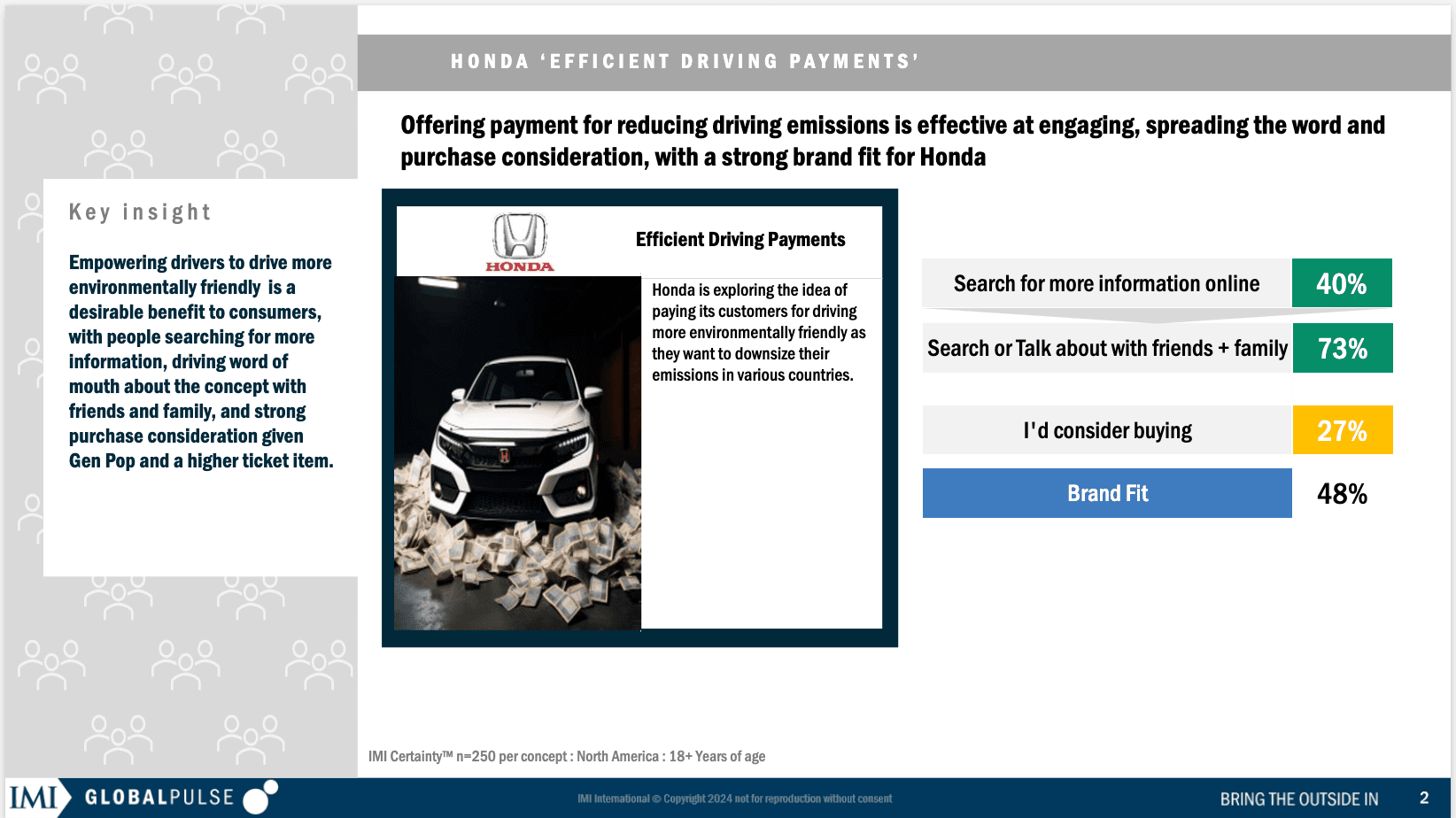
Case study that shows Honda can drive purchase impact and talk value when environmental sustainability is the focus of their campaign. The brand’s authenticity in this arena is illustrated by the high brand fit score.
Brands that support sustainable messaging with meaningful benefits, done so in a legitimate way, it showcases real examples can have strong marketing impact than those relying on aspirational language, corporate social responsibility or purpose-laden statements.
IMI Database Learning: Why Proof-Based Sustainability Marketing Works
The concepts that work because they:
Were concrete, not abstract
Demonstrated commitment over time
Showed cumulative impact rather than one-off gestures
Fit strongly with the brand
For enterprise marketers, the lesson is clear: Specificity beats slogans. Real examples - especially when they show sustained effort -are far more persuasive than high-level claims. They increase credibility, memorability, and shareability.
Cost Effectiveness: Sustainability Lowers the Cost of Brand Growth
From a marketing perspective, sustainability improves cost effectiveness in three critical ways:
1. Reduced Cost of Trust Brands known for strong sustainability credibility face less skepticism and high relevance. This reduces the “trust tax” many enterprise brands pay through heavy promotional spend or discounts.
2. Higher Efficiency of Marketing Spend Sustainability-led brands benefit from higher engagement rates, better content performance and greater earned media (talk-value among social circles) amplification and stronger breakthrough and memorability. Every dollar of marketing works harder when it aligns with customer values.
3. Lower Customer Acquisition and Retention Costs Loyal, values-aligned customers stay longer, recommend more and require less persuasion over time.
Sustainability thus becomes a brand-level efficiency lever, improving ROI across the marketing funnel. The Strategic Risk of Treating Sustainability as Compliance or PR Enterprise organizations that treat sustainability as a reporting exercise, a CSR page or a reputation shield consistently underperform those that integrate it into brand and go-to-market strategy.
Long-term financial outperformance of high-sustainability firms
A seminal academic study compared “High Sustainability” firms (those with deeply integrated environmental and social practices) with “Low Sustainability” firms over an 18-year period. The high-sustainability cohort significantly outperformed their low-sustainability peers in stock returns and accounting performance, indicating that sustainability integration correlates with superior financial performance and shareholder value creation—not just compliance or greenwashing.
Why?
Customers see through surface-level claims
Marketing lacks credibility without substance
Missed opportunity for differentiation and advocacy
Sustainability used defensively protects reputation.
Sustainability used strategically drives growth.
What This Means for Enterprise Marketing Leaders For CMOs and brand leaders, sustainability should be evaluated as:
A brand equity driver
A purchase conversion lever
A WOM and earned media engine
A marketing cost-efficiency strategy
The strongest enterprise brands:
Embed sustainability into brand narrative
Support it with evidence
Activate it consistently across channels
Measure it as a commercial asset
Sustainability Is a Marketing Advantage
Sustainability is no longer about optics or obligation. For enterprise brands, it is one of the most powerful tools available to:
Increase brand value
Drive purchase intent
Generate talk value and advocacy
Improve marketing ROI and cost effectiveness
In an era of declining trust and rising acquisition costs, sustainability offers something rare: authentic differentiation that customers reward with action. Enterprise brands that recognize this will lead their categories. Those that don’t will spend more to achieve less.
If you’re looking to understand how sustainability can strengthen your brand, accelerate consideration, and drive long-term growth, we’d love to talk.