

Clean Innovation for Impact: Turn Sustainability into Market Gains



Not all sustainability initiatives resonate equally, and the brands winning today are those investing in bold, meaningful change that consumers recognize as authentic.
Here's a question worth asking: Is your sustainability strategy actually moving the needle, or is it just checking a box?
We consistently see that helping the environment ranks as a Top 5 concern for North Americans. And over 50% say they'll purchase a product specifically because it helps the environment. Those are significant numbers-and that's mass, not niche. But here's the thing—not all environmental initiatives land equally with consumers. Some generate real brand affinity and competitive separation. Others barely register.
So what makes the difference?
It's about substance, not surface
The brands getting sustainability right aren't just talking about being green. They're making bold, future-focused commitments that signal genuine operational investment—and consumers notice.
Through IMI Pulse©, we've measured how consumers respond to different types of sustainability messaging. The pattern is clear: Initiatives that showcase real business transformation consistently outperform marketing-led programs. When sustainability requires genuine operational change, consumers perceive it as important and authentic rather than performative.
The other factor? Specificity. Vague environmental claims underperform against initiatives with concrete targets and timelines. "We're going green" doesn't resonate the way "4,500 electric vehicles by 2040" does. Specificity signals accountability.
Case in point: Walmart's two different approaches
In March 2023, we evaluated 30 concepts across North America with 9,000 consumer evaluations. Among these, we compared two distinct Walmart programs: the Walmart Creator Platform—a TikTok-style social portal for creators—versus their bold commitment to purchase 4,500 all-electric delivery vehicles to achieve zero emissions by 2040.

The results were instructive:
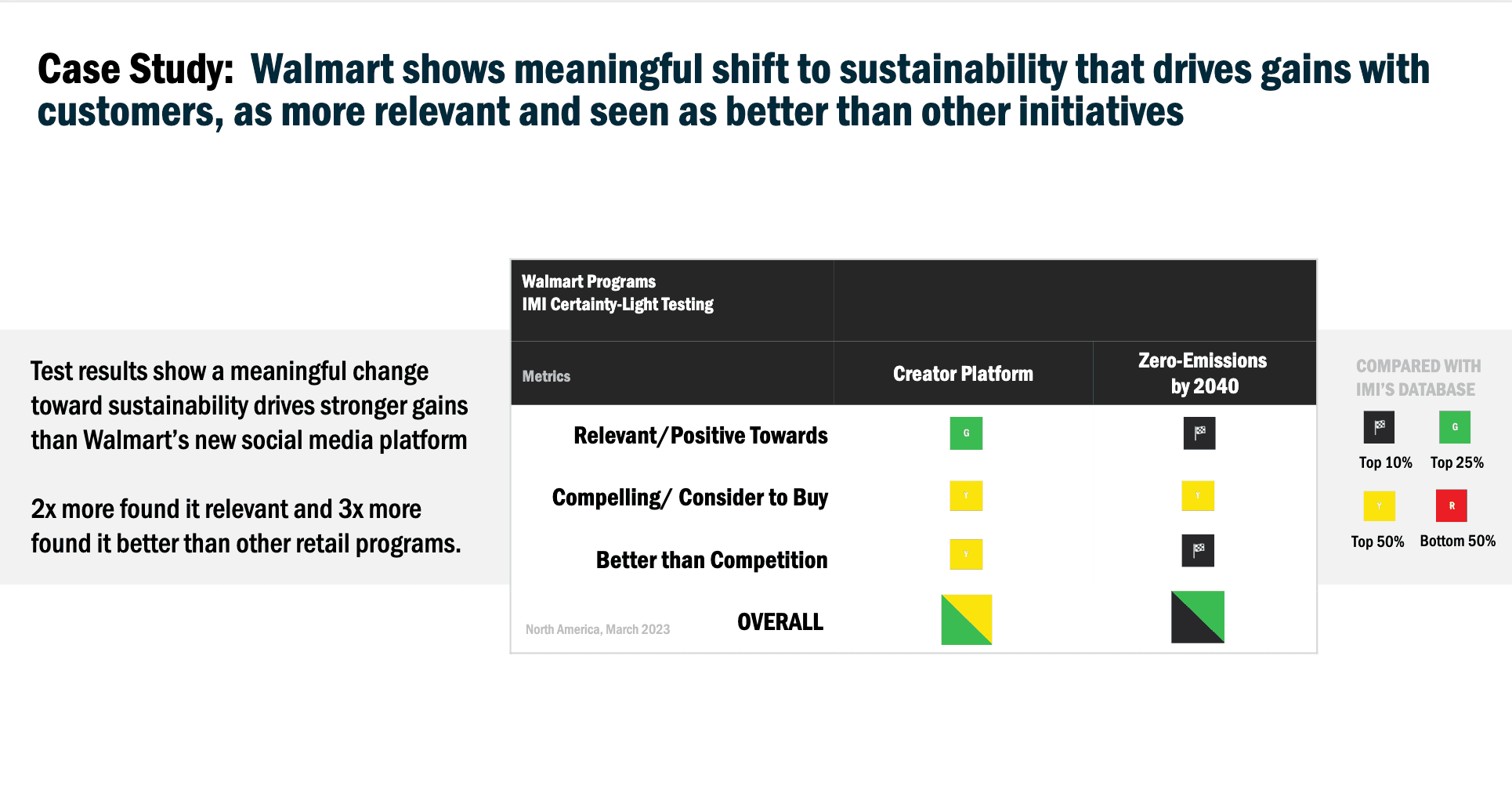
The zero-emissions initiative generated more than double the relevance and over three times the competitive differentiation, reaching IMI’s Green Light target for new program introduction.
The key insight? Commit to bold initiatives that are meaningful to your target. Making a shift to zero emission vehicles shows that Walmart is serious about “walking the talk” on sustainability. Committing to a goal that is a decade away says "big" and drives new news, positivity and competitive standing versus launching a new social platform that does not connote differentiation from competition.
What this means for your brand
Future-focused sustainable initiatives that require genuine operational change outperform short term trending programs—even when those marketing programs offer direct consumer engagement. That's a significant finding for brands weighing where to invest.
Here's how to apply this:
Measure before you launch. Understand baseline consumer expectations in your category to ensure your initiative addresses genuine priorities—not assumed ones.
Test your messaging. How you communicate environmental commitment matters as much as the commitment itself. We can help identify which messaging approaches resonate with your specific audience. For example, consumers resonate more with helping the environment than fighting climate change.
Track competitive differentiation. Sustainability only drives market gains when it distinguishes your brand. Ongoing measurement ensures your initiatives maintain that separation. It's a unique point of difference.
Making sustainability work strategically
Environmental initiatives represent a real opportunity for brands willing to move beyond surface-level commitment. The data shows North American consumers are ready to reward authentic, future-focused sustainability—but only when it shows true commitment and change through commitment and investment.
IMI can help you determine if your programs and messaging will accentuate your brand identity and build your marketing mix for both short-term and long-term business growth.
Contact us to start the conversation.
This is Part 1 of a multi-part series exploring how brands drive business gains through sustainable and environmentally friendly initiatives.