

Canadians Have Adapted to the Tariff War and Are Committed to the "New Normal"



New IMI NextWave© research finds Canadians economically resilient, increasingly committed to buying Canadian, and still fundamentally changing how they think about the United States.
The latest chapter in the Canada-U.S. tariff dispute has arrived, but Canadian consumers aren't responding as though they're facing a new crisis. Instead, the data suggests many have adjusted to the reality of an ongoing trade dispute.
IMI International's latest NextWave study, conducted August 26-27, 2026 among a representative sample of 1,003 Canadians aged 18-70 across Canada, measures Canadians' actions, intentions, emotions and sentiment during the continuing trade dispute.
Compared with our May 2026 research, the findings point to a Canadian consumer who remains personally resilient, is becoming more deliberate in purchasing decisions, and appears increasingly committed to what is emerging as a new normal.
1. Canadians' Personal Outlook Is Holding
Given the continued tariff escalation, it would be reasonable to expect Canadians to feel less optimistic about their jobs, finances and everyday lives. However, that's not what the data shows.
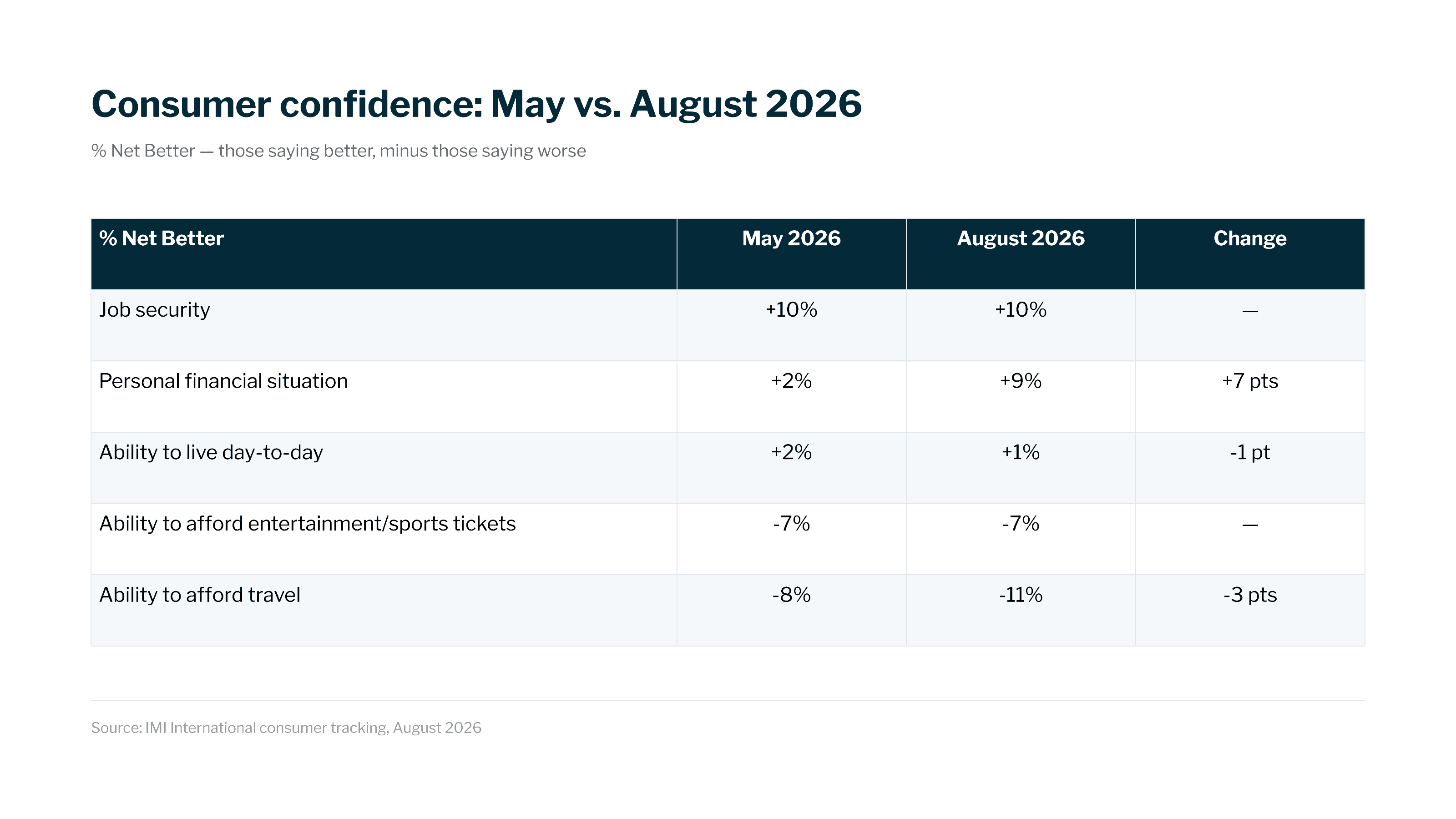
Job-security expectations haven't moved, day-to-day outlook remains largely unchanged, and perceptions around entertainment affordability are virtually identical to where they stood in May.
Most strikingly, Canadians' expectations for their personal financial situation improved seven points, rising from +2% Net Better in May to +9% in August. Travel affordability is the only measure showing some deterioration.
After months of trade uncertainty, Canadians appear increasingly acclimatized to the economic noise. That doesn't mean they believe everything is fine. Rather, it suggests that the ongoing tariff dispute is no longer driving a broad decline in expectations for their own personal circumstances.
2. Buy Canadian Has Become Part of the New Normal
While personal economic confidence remains relatively stable, Canadians continue to make deliberate changes in how and where they spend their money. In August, 61% of Canadians said they had purchased a product in the past month because it was Made in Canada. Meanwhile, 83% have purchased or intend to purchase local products. What's particularly notable is how widespread this behaviour has become. Buying local is not confined to a specific age group, region, or income bracket. Instead, it is showing up consistently across the country: It reaches:
79% of Canadians aged 18–29
82% of those aged 30–44
85% of those aged 45–59
90% of those aged 60–70
85% in Western Canada
84% in Ontario
83% in Atlantic Canada
86% among households earning $125,000+
The breadth of adoption matters because it signals something larger than a short-term consumer reaction. Buying Canadian is no longer simply a political response or the behaviour of a particular demographic segment. It has become a mainstream consumer behaviour embraced by Canadians across a wide range of groups.
3. Canadians Are Putting More Effort Into Finding Canadian Products
The strongest evidence of commitment may not be what Canadians say they intend to do in the future. It may be what they're already doing today. In May, 52% said they had taken extra time in-store to find Canadian products. By August, that had increased to 58%.
Online, the percentage taking extra time to find Canadian providers increased from 42% to 47%.
Future behaviour is stronger still.
79% have or intend to take extra time finding Canadian products in-store, while 74% say the same about finding Canadian providers online.
This represents an important shift in consumer behaviour. Canadians aren't simply expressing support for local products in principle. Increasingly, they're demonstrating a willingness to invest additional time and effort to find Canadian options.
For businesses, that creates a very practical opportunity: make Canadian provenance obvious, easy to identify and easy to buy on packaging, at shelf, at the point of sale, online and throughout customer communications.
4. Adaptation Doesn't Mean Canadians Have Moved On
While Canadians appear to be adapting economically to the tariff environment, their attitudes toward the United States tell a very different story.
In August:
Support for anything American: -37% Net Better
Future intention to travel to the United States: -33% Net Better
The age differences are particularly notable.
Among Canadians aged 18-29, support for anything American sits at -15%. Among those aged 60-70, it falls to -72%.
Future U.S. travel intention follows a similar pattern, moving from -10% among 18-29-year-olds to -61% among Canadians aged 60-70.
In other words, while the economic shock may be becoming normalized, the behavioural and emotional impacts remain very real.
5. Trump Remains a Lightning Rod
Political sentiment tells a similar story. Canadians' changing perceptions register as follows:
Canadian Federal Liberal Party: +10% Net Better
Prime Minister Mark Carney: +14%
President Donald Trump: -50%
Trump's result falls to -82% among Canadians aged 60-70, while remaining negative across every age, gender, regional and income segment reported in the study.
The New Normal: Resilience + Resolve
Taken together, these findings suggest something more significant than a temporary reaction to another round of tariffs.
Canadians appear to be adapting to this environment. Expectations around jobs and everyday life have remained remarkably stable since May, while personal financial outlook has actually improved.
What adaptation hasn't meant, however, is a return to previous behaviours.
61% recently bought because a product was Made in Canada.
83% have or intend to buy local.
58% are taking extra time in-store to find Canadian products, up six points since May.
At the same time, attitudes toward American products, U.S. travel and President Trump remain strongly negative.
That is why the key finding from this research goes beyond a simple "Buy Canadian" narrative. Instead, we're seeing the emergence of a new Canadian consumer normal that appears increasingly durable rather than temporary.
Canadians are becoming more resilient, more deliberate in their purchasing decisions, more willing to invest effort in finding Canadian products, and more committed to supporting local businesses.
For Canadian businesses, the opportunity is equally clear:
If you're Canadian, don't make consumers search to find that out. Make it visible. Make it meaningful. And make it easy to buy.